What is working at height? There are two possible answers.
The first one is obvious – it’s working above ground level. But the second one isn’t as straightforward and covers more activities than you might think.
Read our guide to learn the legal definition of working at height, and the guidance you must follow if the work you’re carrying out qualifies.
The Legal Definition of Working at Height
Working at height is legislated under The Work at Height Regulations 2005, which defines it as:
It’s important to note that working at ground level (or lower) can still qualify as working at height if there’s a risk of falling through a fragile surface or open hole of some kind.
The Work at Height Regulations 2005 also apply if there’s a risk of falling when accessing or leaving a worksite by any means other than a permanent staircase.
What About Slips and Trips?
Slips and trips at ground level are legally separate from working at height. As explained by the Health and Safety Executive (HSE), which enforces the relevant legislation, a fall from height must be from one level to a lower level.
And there’s no minimum distance. The Work at Height Regulations apply whenever there’s a risk of a fall-related injury, whether it’s from a stepladder or scaffold.
Working at Height Training
Our Working at Height Training course explains the regulations, risks and safety measures of working above ground level. It provides employees and employers with awareness of their legal responsibilities and the necessary precautions to ensure work at height is safe.
What are the Dangers of Working at Height?
Work-Related Fatality
Falls from height are the leading cause of workplace fatalities.
According to the HSE, there were 124 work-related fatal injuries in 2024/25. Falls from height caused 35 of them.
Statistics were similar in 2023/24, when falls from height were also the leading cause of workplace fatalities, killing 49 people.
You could go back further through the HSE’s records and see the same pattern. Falls from height are the most common cause of fatal accidents at work and have been for some time.
Workplace Injury
Falls from height are also one of the top causes of non-fatal reportable workplace injuries, representing 8% of incidents last year.
This makes them the fifth most common cause of reportable accidents. While falls aren’t as common an accident as slips and trips or manual handling injuries, which take the top two spots, the consequences are typically more severe.
Workers who fall are far more likely to suffer a serious, reportable injury or worse.

How Do I Keep Workers Safe When Working at Height?
Under the Work at Height Regulations, before you commit to any work activities at height, you must consider if there’s a reasonably practicable way to do the work from ground level.
Doing so completely eliminates the risk of falling.
If work at height is unavoidable, you must take steps to make it safe. Your primary duties are:
- Properly planning for and organising work at height
- Confirming that all those involved in work at height are competent
- Assessing risks and implementing suitable control measures, including fall protection
There is plenty of HSE guidance to help you ensure compliance
What Is Fall Protection?
Fall protection describes the set of measures used to either prevent a fall from happening or minimise the distance and force of a fall so injury is less likely.
You can split these protective measures again into either collective or personal. Collective protection makes multiple people safer at once, whereas personal protection only benefits the individual using it.
The regulations make the hierarchy clear: collective protection takes priority over personal protection.
Collective Protection
Collective systems are largely passive, meaning safety doesn’t depend on a person remembering to clip on or adjust their kit correctly.
They include:
- Properly designed working platforms with guardrails, mid-rails, toe boards and secure access
- Scaffolding systems erected, altered and inspected by competent persons
- Mobile elevating work platforms (MEWPs), which provide a stable, enclosed platform for short-duration tasks
Edge protection and barriers around roof perimeters, floor openings and leading edges - Covers and decking over voids, service pits and fragile surfaces
- Safety nets/soft-landing systems installed below work areas where prevention at the edge is not practicable
Personal Fall Protection
Personal systems only protect the wearer. Used correctly (and only after collective options have been exhausted), these systems provide critical, last-line protection for work at height.
They span three types:
- Work restraint: a full-body harness with a fixed-length or adjustable lanyard set so the user cannot reach the edge
- Fall arrest: a full-body harness used with an energy-absorbing lanyard or self-retracting lifeline (SRL) to limit forces and stop a fall
- Work positioning/rope access: systems that hold the worker in place at height, used by trained, competent personnel under a safe system of work
Whatever system is used, personal fall protection must be:
- Task-specific and correctly fitted to the user
- Anchored to suitable points with verified strength and compatibility
- Subject to pre-use checks and formal inspections at set intervals
- Supported by a rescue plan, so that a fallen worker can be recovered quickly and safely
Ladders and Step Ladders
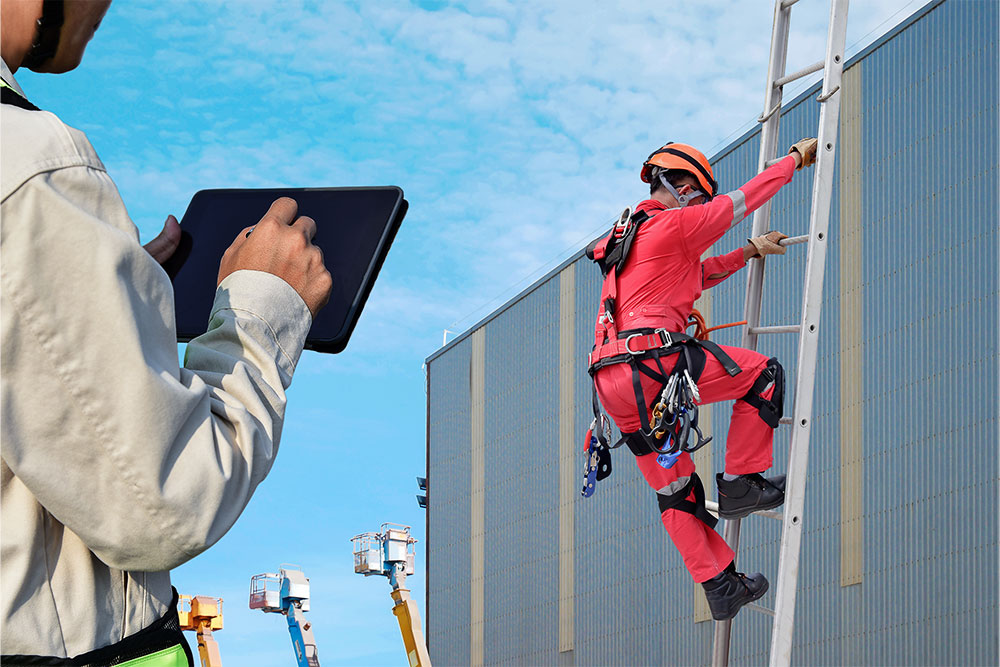
Most people fall when working from a ladder or a stepladder, so you must know how to use them safely.
Following HSE guidance, ladders and stepladders should only be used when a safer option, such as scaffolding or MEWP, isn’t practical.
Generally, this means ladders are only safe for short, simple tasks that:
- Take no more than 30 minutes to complete
- Allow the worker to keep three points of contact on the ladder at all times (either two hands and one foot, or two feet and one hand)
The ladder must also be suitable, in a safe working condition and set up correctly. Full requirements are set out in Schedule 6 of the Work at Height Regulations.
Competence
It’s a common myth that employees need to be qualified to work at height. In practice, workers need to be competent, not strictly qualified.
So, if you’re an employer (or supervising work at height), you must ensure that anyone you appoint has the right skills, knowledge and experience to safely do the job. The required skills, knowledge and experience scale with the complexity of the task.
For simple, low-risk activities, employees may require awareness-level training to ensure they understand the risks involved and how to use any provided equipment. For complex, high-risk jobs, further training and experience will be needed.
There’s a wide range of training programmes out there, with most offering some certificate that proves a certain level of knowledge. Certification is a strong indicator of competence when choosing who does what, but it’s not enough on its own. It must be complemented with practical experience and skills.
Appropriate Training
Providing employees with the right training not only supports your legal duties but also creates safer workplaces.
While some training can be delivered on the job, online courses allow workers to build core knowledge before stepping onto site. This means they arrive prepared, confident and ready to work safely, while experienced staff can focus on more complex tasks rather than inducting new starters.
Our online Working at Height Training course teaches the principles of safe work at height, and explains how risk assessments are used to keep workers safe.
Enrol today. Start building competence and help prevent avoidable falls in your workplace.