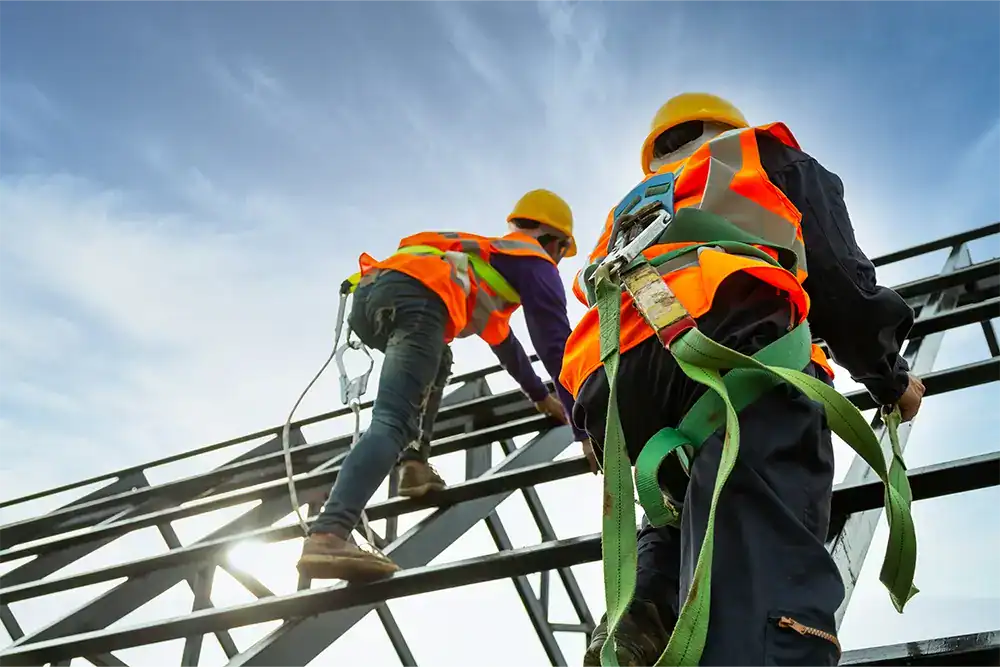
Falls from height are the most common work-related fatal accident in the UK. Construction workers face the highest risk, but they’re not the only ones. Maintenance staff, warehouse operatives and anyone else working at height are also vulnerable. Falls from just 2 metres can kill.
Where these risks exist, employers must comply with the Work at Height Regulations 2005. One of its key requirements is the use of an appropriate fall protection system.
This blog explains the main types of fall protection systems and when they’re effective. Whether you work at height or supervise those who do, it will help you choose a solution that’s both compliant and practical.
Key Takeaways: Types of Fall Protection Systems
- Fall protection systems are methods and equipment used to either prevent people falling from height or reduce the risk of injury.
- They are grouped into two categories: collective systems (protect everyone without action by individuals) and personal systems (protect one person using harnesses or lines).
- Main types of collective protection include guardrails and safety nets.
- Personal protection systems include fall restraint, fall arrest and rope access.
- Use collective systems first, and only rely on personal systems when collective options are not practical.
Understanding Fall Protection Systems
A fall protection system refers to the equipment, devices, measures and techniques used to either prevent a person from falling or reduce the risk of injury when a person does fall.
These systems are required under the Work at Height Regulations 2005, which state appropriate measures must be implemented to prevent falls or reduce their consequences where work at height cannot be avoided.
Fall Protection Training
This IIRSM-approved online course provides an essential awareness of fall protection measures and methods, as well as duties under the Work at Height Regulations. Equip teams with practical knowledge that reduces fall risks and improves safety on-site.
What Does The Law Say
The Work at Height Regulations 2005 apply to all work where a fall could cause injury. Employers and those in control of the work must follow a strict hierarchy to comply:
- Avoid work at height entirely if the job can be done from the ground.
- Prevent falls with collective protection before turning to personal equipment.
- Minimise the consequences with systems like nets or fall arrest blocks where risks remain.
Types of Fall Protection Systems
There are two main types of fall protection systems.
Collective Protection Systems
Collective protection systems (also called collective safeguards) work passively for multiple people at once. It’s often built into the environment or the work equipment, such as guardrails on scaffolding.
Collective fall protection must be prioritised over personal protection.
Personal Protection Systems
Personal fall protection systems are those in which the safety of the individual depends on the correct use of personal equipment (harness, lanyard, line, etc.).
While essential in some situations, personal protection systems shouldn’t be your first choice for work at height. They can only protect one person at a time, and only when used correctly.
Well-designed collective protection is more reliable and wide-ranging, which is why it’s preferred whenever practical.
Examples of Fall Protection Systems
Collective Protection Systems
Collective systems are considered first because they provide passive protection. Once installed, they protect everyone at risk without needing action by individual workers. Common collective systems include guardrails, safety nets and soft landing systems.
Guardrails
Guardrails are fixed barriers placed along open edges, scaffolds, walkways or platforms to stop falls. They are designed to block access to danger zones rather than deal with the consequences of a fall.
They must be fixed in place securely and reach a minimum safe height. They also need enough strength and stability to take the weight of a person leaning or falling against them.
The materials used for guardrails must suit the working conditions and be kept in good repair so they can continue to protect workers effectively.
Schedule 2 of the Work at Height Regulations 2005 explains how guardrails must be used when there is a risk of falling from an edge.

Safety Nets and Soft Landing Systems
Safety nets and soft landing systems, such as airbags or cushioned platforms, are collective safeguards designed to catch or cushion a person if they fall, thereby absorbing the impact and limiting injury.
These systems should always be positioned as close as possible to the work area to reduce fall distance. They must be suitable for the environment, kept in good condition and used by trained workers with proper rescue arrangements in place.
Schedule 4 of the Work at Height Regulations 2005 outlines the requirements for applying these systems.

Personal Protection Systems
Personal protection systems protect one person at a time and must only be used when collective measures are not possible.
The main types are:
Fall Restraint
A fall restraint system stops the worker from reaching a point where a fall could happen.
It uses a full-body harness connected by a fixed-length lanyard to a secure anchor. The lanyard is set so the worker cannot physically reach an edge or opening to fall.
This system is considered safer than fall arrest because it prevents a fall altogether, but it must be adjusted correctly to keep the wearer safely away from the fall hazard while still allowing enough movement to work.
Fall Arrest
A fall arrest system won’t prevent a fall, but will catch the wearer midair to prevent severe impact injuries.
It uses a full-body harness linked to a secure anchor point, often with an energy-absorbing lanyard or a self-retracting lifeline.
The system must be set up to limit the force on the body and prevent the worker from hitting the ground or other surfaces. A rescue plan must also be in place so the worker can be recovered quickly after the fall is stopped.
Work Positioning
Work positioning systems hold a worker in place while they carry out a task, leaving both hands free. The harness and connecting equipment keep the worker in a stable position on a vertical or inclined surface, such as a pole or mast.
A separate backup, usually a fall arrest system, must always be included in case the primary support fails.
Rope Access
Rope access systems use ropes, harnesses and specialist equipment to allow workers to reach areas that would otherwise be inaccessible.
In a rope access system, there are typically two independently anchored lines: a working line and a safety line. The working line supports and moves the worker, while the safety line serves as a backup with a mobile fall protection device.
Workers must be trained and competent to use rope systems safely, and the equipment must be arranged to minimise free-fall distance.
The Importance of Training
The Work at Height Regulations 2005 require employers to ensure that anyone working at height is competent and trained to do so safely.
We offer an online training course that supports this need. It helps workers select the right fall protection equipment, use it correctly and recognise common risks on site. The training also covers equipment inspection and maintenance best practices, as well as the importance of planning for emergencies.
Providing this training helps your employees select the right equipment and use it safely when working at height, reducing injury risks and supporting compliance on-site.