Level 2 Food Safety in Catering

Level 2 Food Safety in Catering

schedule

Course Duration: Approximately 4 hours

This IIRSM-approved course equips catering staff with the complete knowledge required to handle, prepare and serve food safely.

Across six modules, trainees learn how to maintain food safety in high-risk environments. This includes detailed guidance on hygiene, food handling and preventing cross-contamination and cross-contact. The course also introduces the principles of HACCP (Hazard Analysis and Critical Control Points) and how this system is applied to control food safety risks.

This course meets training benchmarks for food workers directly involved in food preparation, helping businesses comply with food safety law and maintain the standards customers expect.

live_tv
100% online training
volume_up
Full audio voiceover
repeat_on
Fully online assessment
account_balance_wallet
Discounts when you buy in bulk
important_devices
Access on any device
app_shortcut
App available for iOS & Android
Training You Can Trust

Approved by IIRSM

Aligned with UK Legislation

Certificate on completion

Developed by health and safety professionals

L2 Food Safety in Catering Certificate
Level 2 Food Safety in Catering
IIRSM-logo-for-website-131224
£35.00 +VAT

Discounts  for bulk purchases

Need Help?

£35.00 +VAT

Course Preview

Course Details

Course Duration Approximately 4 hours
Approval body IIRSM
Format Fully online
Assessment Multiple choice
Certification Same-day digital certificate
Certificate Valid For 3 years

Suitable For

Cooks and Kitchen Assistants

Hospitality Staff

Wait Staff

Food Truck Vendors

Event Catering Crews

Catering Supervisors

Course Content

This course contains the following modules:

Introduces staff to food safety standards, including the legal framework that protects customers and the responsibilities of both employers and food handlers.

  • Why Food Safety Matters
  • The Legal Background
  • Enforcement & Compliance
  • What Your Employer Must Do
  • What You Must Do
  • Food Safety Management Systems

Sets out requirements for personal hygiene, conduct and appearance when working with food. This includes guidance on handwashing, personal protective equipment, illness reporting and cleaning routines.

  • Personal Hygiene & Cleanliness
  • Personal Items
  • Personal Appearance & Conduct
  • Glass, Sharp Objects & Restricted Items
  • Changing Clothes & PPE
  • Keeping Food Handling Areas Clean

Introduces the four main types of food hazards and how they can be controlled through safe handling, storage and preparation.

  • Microbiological Contamination
  • How Contamination Happens
  • Allergens
  • Chemical Contamination
  • Physical Contamination
  • Pests
  • Preventing Contamination Through Safe Handling

Explains how HACCP principles are used to develop effective food safety management systems. The module also covers standards for cleaning, pest control and supplier checks in HACCP systems.

  • Introduction to Food Safety Management
  • Food Purchasing
  • Delivery & Receipt of Food
  • Storing & Decanting Food
  • Preparation of Allergen-Free Foods
  • Training & Hygiene
  • Labelling Guidelines
  • Product Recall

Covers how to properly clean and maintain food handling areas to ensure a safe food catering environment, including guidance on colour-coding, waste disposal and record keeping.

  • Keeping Areas Clean
  • Types of Cleaning Procedures
  • Cleaning with Chemicals
  • Colour-Coding
  • Disinfection

Describes how to store food safely to prevent spoilage, contamination and waste. Explains temperature control, stock rotation, segregation of raw and cooked foods and pest prevention.

  • The Importance of Date Marking
  • The Importance of Labelling
  • The Importance of Storage Procedures

What You Will Learn

The legal duties and food safety standards that apply to catering and hospitality

The four main types of food safety hazards and how to control them

Safe methods for handling, cooking, cooling and storing food

HACCP principles and how food safety management systems are used to control risks

How to carry out basic food safety checks and monitoring

How to manage allergens and prevent cross-contact during preparation and service

Available in 13 Languages

Course subtitles are available in multiple languages, including:

French

Dutch

German

Italian

Spanish

Polish

Course Approval Body

IIRSM-logo-for-website-131224

Approved by IIRSM

This course is approved by the International Institute of Risk & Safety Management (IIRSM).

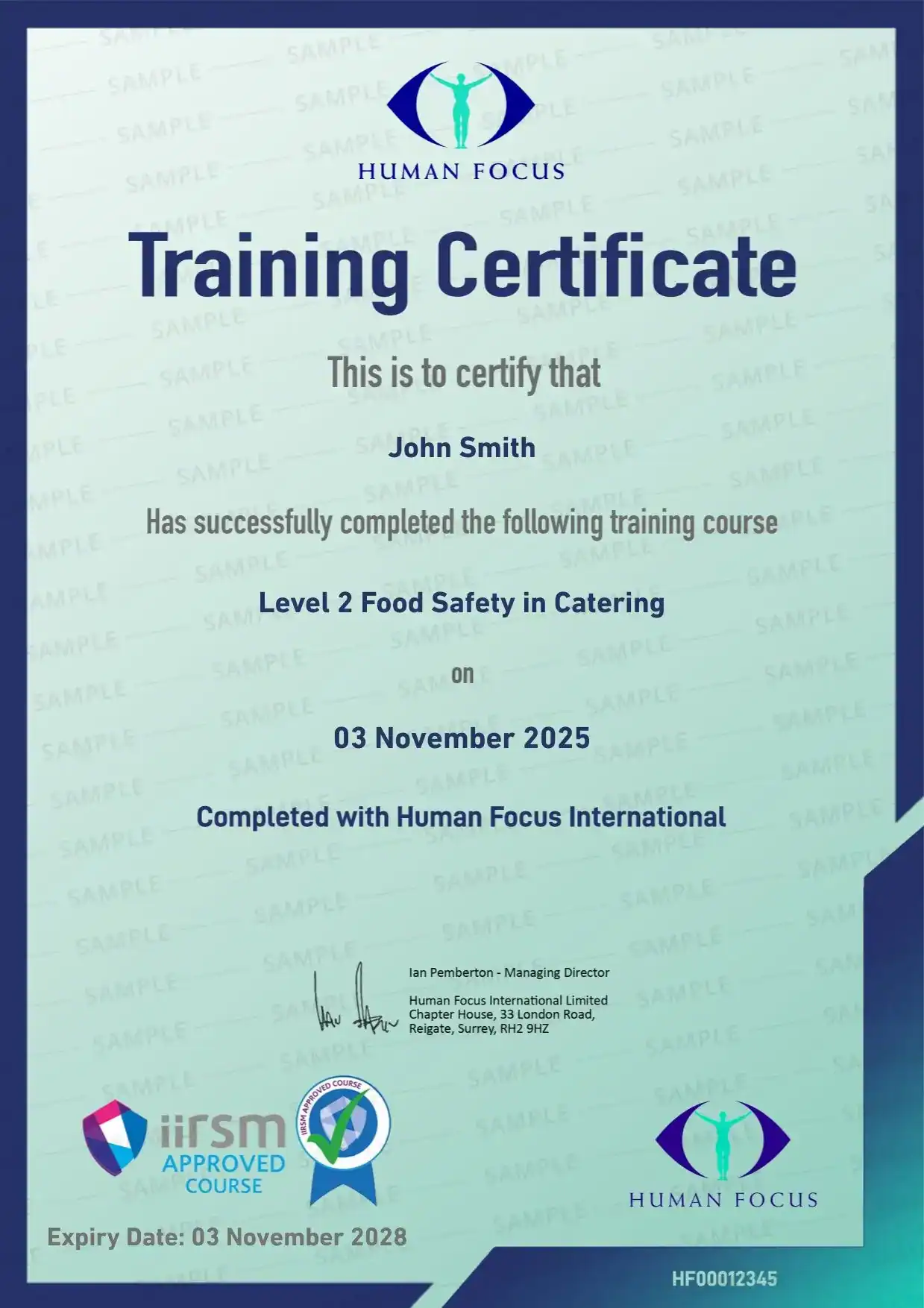
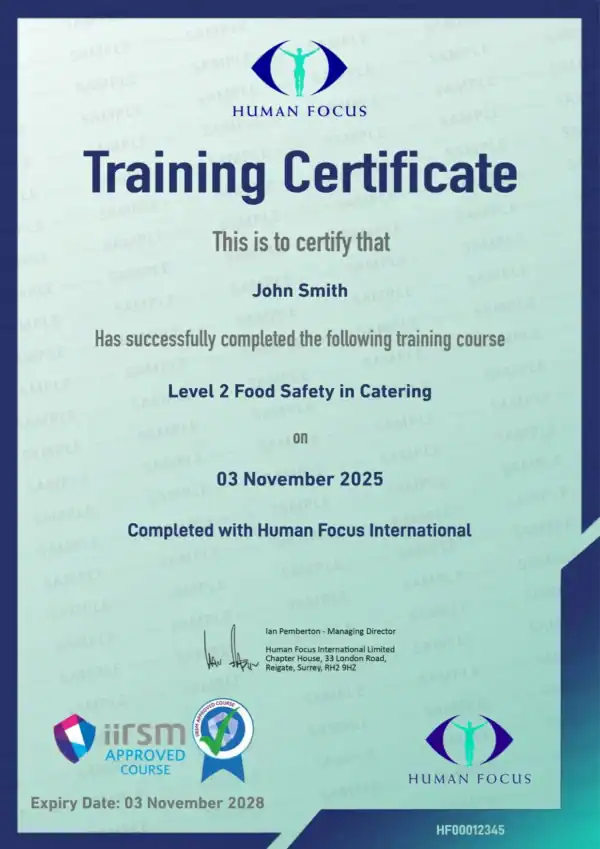
The course certificate includes:

  • User name
  • Company name
  • Course name
  • Completion date
  • Expiry date
  • Approval body

An IIRSM-approved course certificate will be available for download and printing instantly upon course completion.

Users must complete a final theory test before earning their certificate.

The end-of-course test is:

  • Fully online
  • Multiple choice

A score of 80% is required to pass.

L2 Food Safety in Catering Certificate

Customer Feedback

Why Is Level 2 Food Safety Training in Catering Important?

Level 2 Food Safety in Catering Training is the recognised benchmark for catering and hospitality staff who handle or prepare open food. These roles carry greater food safety risks, requiring workers to understand how contamination occurs and how to prevent it. They must also be able to follow and apply food safety management systems based on HACCP, a legal requirement for all food businesses.

This course provides the essential knowledge to meet those expectations. It covers the full scope of food safety practice, including hygiene, allergen control, temperature management and the safe preparation, storage, transport and service of food. Learners also gain a clear understanding of HACCP principles and the legal standards that guide everyday catering operations.

Completing this training supports stronger compliance and safer food handling across your organisation. It helps reduce the risk of foodborne illness, enhances customer confidence and contributes to a more successful catering business.

Related Courses